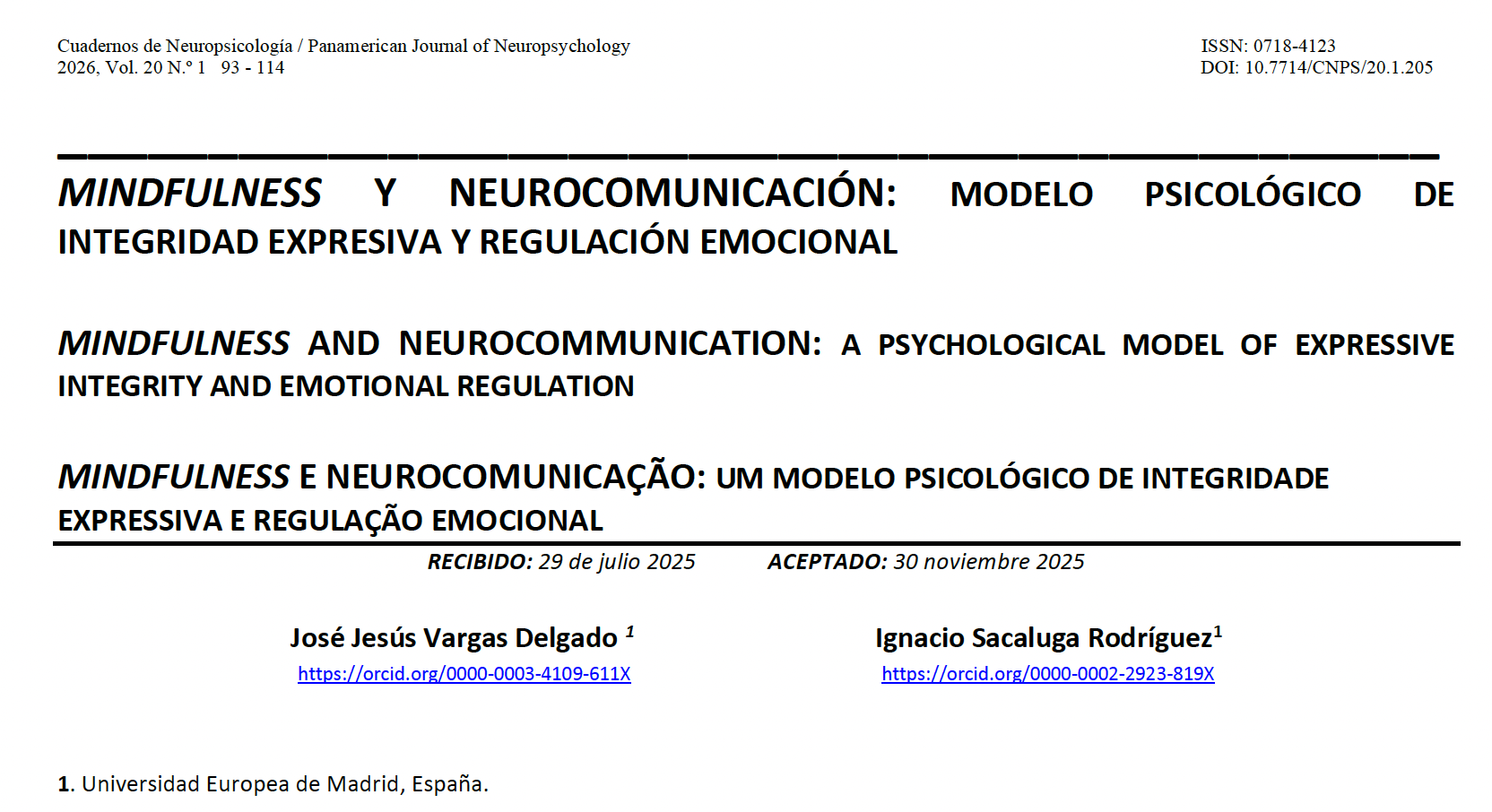
MINDFULNESS AND NEUROCOMMUNICATION: A PSYCHOLOGICAL MODEL OF EXPRESSIVE INTEGRITY AND EMOTIONAL REGULATION
Abstract
This research explores the psychological effects that sustained mindfulness practice exerts on the communicative dimension of the human being, with particular emphasis on discursive authenticity, emotional coherence, and expressive integrity. Far from reducing communication to a strategy of persuasion or performance, this work proposes a deeper and more transformative perspective, wherein communication becomes an act of lucid presence, human connection, and shared truth. Mindfulness practice not only enhances self-regulation and verbal fluency but also transforms the subject’s relationship with their own speech. By developing greater awareness of the mental and emotional processes preceding verbal expression, defensive patterns, linguistic automatisms, and expressions conditioned by the need to please, compete, or persuade begin to dissolve. A cleaner, non-reactive, and present-rooted mode of communication emerges. This investigation analyzes how mindfulness fosters the disidentification from the discursive ego and facilitates the emergence of a more coherent "communicative self," less conditioned by external judgment and more connected to inner experience. It also examines the psychological processes involved in the transition from communication based on masks toward a more honest, ethical, and transpersonal expression, where words arise unadorned and become gestures of relational care. The methodology is based on a critical review of recent studies on mindfulness, authenticity, psychological transformation, and conscious communication, integrating insights from neuroscience, humanistic psychology, and transpersonal psychology. Special attention is given to the internal mechanisms of change that allow the subject to inhabit communicative acts with full, non-reactive awareness. In essence, communicating mindfully is not about speaking better, but about speaking truthfully. It does not seek to impress, but to be present. It does not pursue impact, but connection. This research thus proposes a shift from strategic discourse to genuine expression—one that arises from inner silence and reaches the other without interference, armor, or pretension.
Published
How to Cite
Issue
Section
License
Copyright (c) 2026 José Jesús Vargas Delgado, Ignacio Sacaluga Rodríguez

This work is licensed under a Creative Commons Attribution-NonCommercial-ShareAlike 4.0 International License.
Articles published in this journal are protected under the Creative Commons Attribution-NonCommercial-ShareAlike 4.0 International (CC BY-NC-SA 4.0) license. This means that authors retain full rights over their research and publications at all times. As a journal, we fully respect and promote the principles of open access established by this license, allowing the work to be shared, adapted, and distributed for non-commercial purposes, provided that appropriate credit is given to the authors and any derivative works are licensed under the same terms.
Authors are responsible for obtaining the required permission when they wish to reproduce part of the material (figures, etc.) from other publications.
Likewise, CNPs allows authors to host in their personal sites or other repositories that they deem convenient the Final and Definitive Version of the published article with the format assigned by the journal. In no case do we allow access to preprints of the article under evaluation or already published.
When submitting an article to CNPs you are aware that all the contents of CNPs are under a Creative Commons License. In which it is allowed to copy and share the contents freely, always making reference to the origin of the publication and its author.