BEYOND LANGUAGE: GENERALIZED NEUROCOGNITIVE DYSFUNCTION IN MEXICAN SCHOOLCHILDREN WITH DEVELOPMENTAL LANGUAGE DISORDER
Abstract
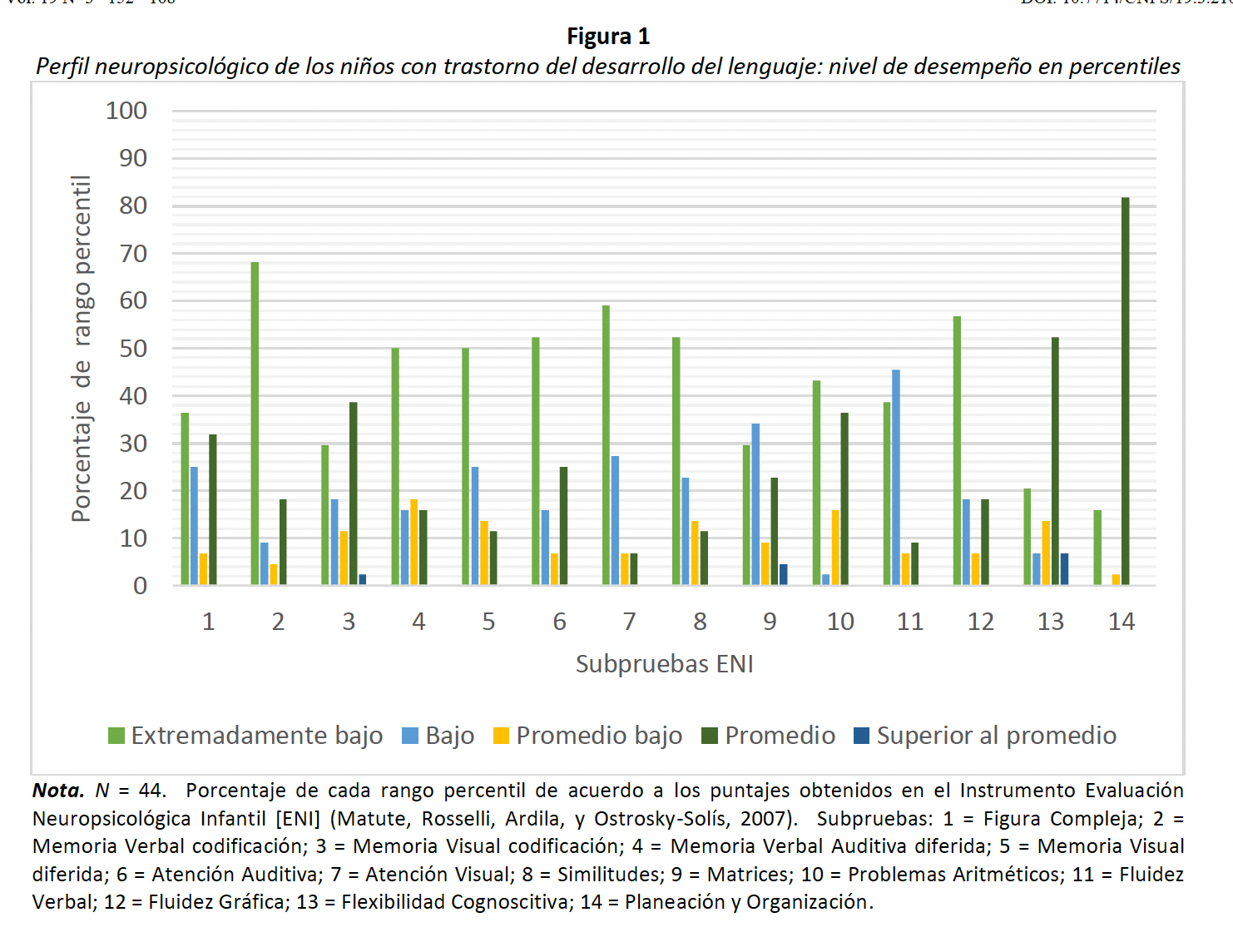
Neuropsychological performance of 44 mexican schoolchildren with expressive (TDLE) or receptive-expressive (TDLRE) developmental language disorder (TDL), aged 6 to 10 years, of medium-low socioeconomic status, from public elementary schools in the metropolitan area of México City, was analyzed. The Child Neuropsychological Assessment [ENI] (Matute, Rosselli, Ardila y Ostrosky - Solís, 2007) was applied. For the total sample, the observed performance was located in an extremely low percentile in all neuropsychological skills evaluated except visual memory (encoding), cognitive flexibility, planning and organization, which reached an averange range percentile. Significant differences were found in auditory-verbal and visual delayed memory, verbal and visual attention, conceptual functions, and arithmetic reasoning in children with TDLE compared to children with TDLRE. There is a relationship between language development and neuropsychological skills evaluated. TDL is associated with widespread dysfunction of multiple cognitive functions.
Downloads
Published
How to Cite
Issue
Section
License
Copyright (c) 2025 Anahí Cervantes-Luna

This work is licensed under a Creative Commons Attribution-NonCommercial-ShareAlike 4.0 International License.
Articles published in this journal are protected under the Creative Commons Attribution-NonCommercial-ShareAlike 4.0 International (CC BY-NC-SA 4.0) license. This means that authors retain full rights over their research and publications at all times. As a journal, we fully respect and promote the principles of open access established by this license, allowing the work to be shared, adapted, and distributed for non-commercial purposes, provided that appropriate credit is given to the authors and any derivative works are licensed under the same terms.
Authors are responsible for obtaining the required permission when they wish to reproduce part of the material (figures, etc.) from other publications.
Likewise, CNPs allows authors to host in their personal sites or other repositories that they deem convenient the Final and Definitive Version of the published article with the format assigned by the journal. In no case do we allow access to preprints of the article under evaluation or already published.
When submitting an article to CNPs you are aware that all the contents of CNPs are under a Creative Commons License. In which it is allowed to copy and share the contents freely, always making reference to the origin of the publication and its author.