DO THEY MEASURE THE SAME CONSTRUCT? AN ANALYSIS OF SHARED COGNITIVE DEMANDS BETWEEN NONVERBAL FLUENCY AND COMPLEX FIGURE COPYING IN ADULTS
Abstract
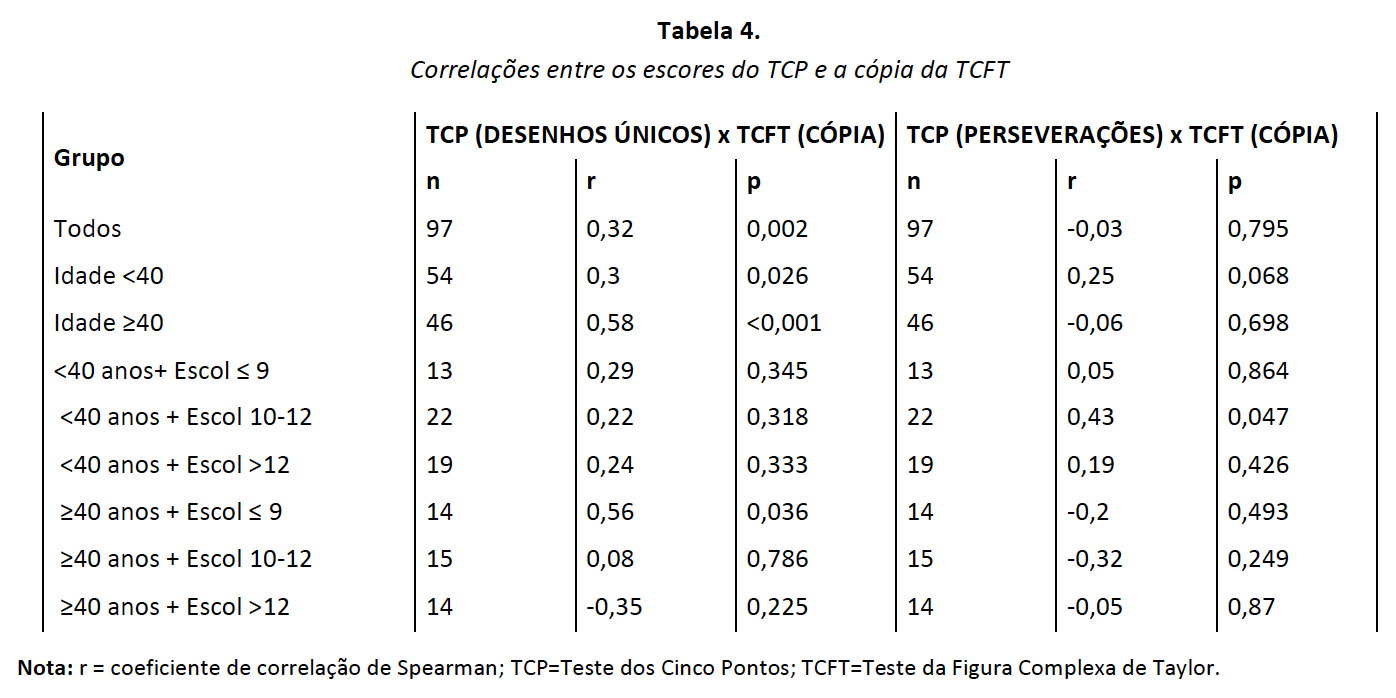
The Five-Point Test (FPT) and the Rey–Osterrieth Complex Figure (ROCF) and Taylor Complex Figure Test (TCFT) are widely used instruments in neuropsychological assessment of executive functions and visuospatial abilities. Despite their frequent use in clinical practice, no studies have directly examined the association between these measures. This study investigated the associations between performance on the FPT and the copy stage of the ROCF and TCFT, exploring the relationship between nonverbal fluency and visuospatial planning in healthy adults from Southern Brazil. The sample included 188 adults, distributed into two groups: Group 1 (ROCF; n = 91) and Group 2 (TCFT; n = 97). All participants also completed the FPT. Associations between the number of unique designs and perseverations on the FPT and the copy scores of the figures were examined using Spearman’s correlation coefficient. A moderate correlation was observed between the number of unique designs on the FPT and ROCF copy performance (r = 0.45, p < 0.001) and TCFT (r = 0.32, p = 0.002). The comparison between correlation coefficients using Fisher’s z transformation did not indicate a statistically significant difference (z = 1.03, p = 0.30). Perseverations were not significantly associated with copy scores. These findings suggest partially shared cognitive demands related to visuospatial organization and graphic planning. Stratified data by age and education are also presented, updating parameters for clinical interpretation.
Keywords: Executive Functions; Visuospatial Processing; Neuropsychological Tests; Verbal Fluency; Adults.
Published
How to Cite
Issue
Section
License
Copyright (c) 2026 Luiza Cury Muller, Maria Joana Mäder-Joaquim, Luciano de Paola, Carlos Eduardo Soares Silvado

This work is licensed under a Creative Commons Attribution-NonCommercial-ShareAlike 4.0 International License.
Articles published in this journal are protected under the Creative Commons Attribution-NonCommercial-ShareAlike 4.0 International (CC BY-NC-SA 4.0) license. This means that authors retain full rights over their research and publications at all times. As a journal, we fully respect and promote the principles of open access established by this license, allowing the work to be shared, adapted, and distributed for non-commercial purposes, provided that appropriate credit is given to the authors and any derivative works are licensed under the same terms.
Authors are responsible for obtaining the required permission when they wish to reproduce part of the material (figures, etc.) from other publications.
Likewise, CNPs allows authors to host in their personal sites or other repositories that they deem convenient the Final and Definitive Version of the published article with the format assigned by the journal. In no case do we allow access to preprints of the article under evaluation or already published.
When submitting an article to CNPs you are aware that all the contents of CNPs are under a Creative Commons License. In which it is allowed to copy and share the contents freely, always making reference to the origin of the publication and its author.