WHEN THE MIND WANDERS: SCALE VALIDATION AND ITS RELATIONSHIP WITH CREATIVITY AND EXECUTIVE FUNCTIONS IN ARGENTINE ADULTS
Abstract
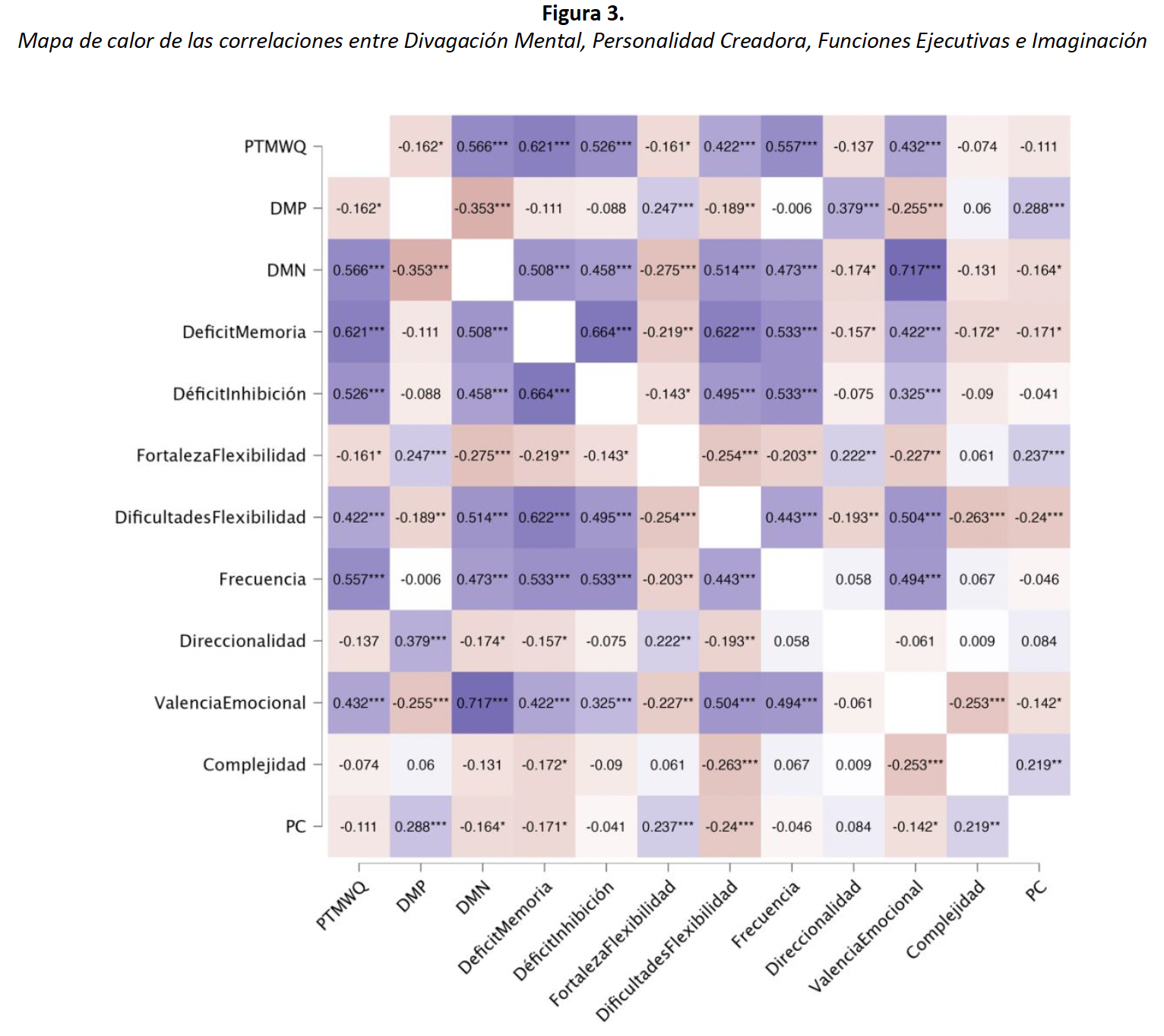
The aim of the study was to validate two complementary instruments for the Argentine population: the Mind-Wandering Questionnaire (MWQ) and the Mind Wandering and Emotional Valence Scale (EDMVE), and to examine their relationships with creative personality, imagination, and executive functions. Participants were 201 Argentine adults (74.1% women, M = 32.5 years). Scales of creative personality (EPC), imagination (FFIS), inhibition and working memory (ADEXI), and cognitive flexibility (CFS) were administered. Confirmatory Factor Analyses with robust DWLS estimator and Spearman correlations were performed. The MWQ maintained a unifactorial structure (CFI = 1.00, RMSEA = .00, ω = .89). The EDMVE confirmed a two-factor structure (CFI = .997, RMSEA = .020, ω = .77-.93). Evidence of convergent validity between MWQ and negative mind wandering, discriminant validity between EDMVE factors, and concurrent validity with external variables were obtained. Valid and reliable Argentine versions of both instruments were obtained, providing complementary tools to assess mind wandering from general and emotional perspectives.
Keywords: mind wandering; confirmatory factor analysis; creative personality; executive functions; imagination; psychometric properties
Published
How to Cite
Issue
Section
License
Copyright (c) 2026 Yanel Tumino, Gabriela Krumm

This work is licensed under a Creative Commons Attribution-NonCommercial-ShareAlike 4.0 International License.
Articles published in this journal are protected under the Creative Commons Attribution-NonCommercial-ShareAlike 4.0 International (CC BY-NC-SA 4.0) license. This means that authors retain full rights over their research and publications at all times. As a journal, we fully respect and promote the principles of open access established by this license, allowing the work to be shared, adapted, and distributed for non-commercial purposes, provided that appropriate credit is given to the authors and any derivative works are licensed under the same terms.
Authors are responsible for obtaining the required permission when they wish to reproduce part of the material (figures, etc.) from other publications.
Likewise, CNPs allows authors to host in their personal sites or other repositories that they deem convenient the Final and Definitive Version of the published article with the format assigned by the journal. In no case do we allow access to preprints of the article under evaluation or already published.
When submitting an article to CNPs you are aware that all the contents of CNPs are under a Creative Commons License. In which it is allowed to copy and share the contents freely, always making reference to the origin of the publication and its author.