ENHANCING PERCEPTUAL REASONING THROUGH ACTIVE CALCULUS INSTRUCTION: A NEUROPSYCHOLOGICAL PILOT STUDY IN ENGINEERING EDUCATION
Abstract
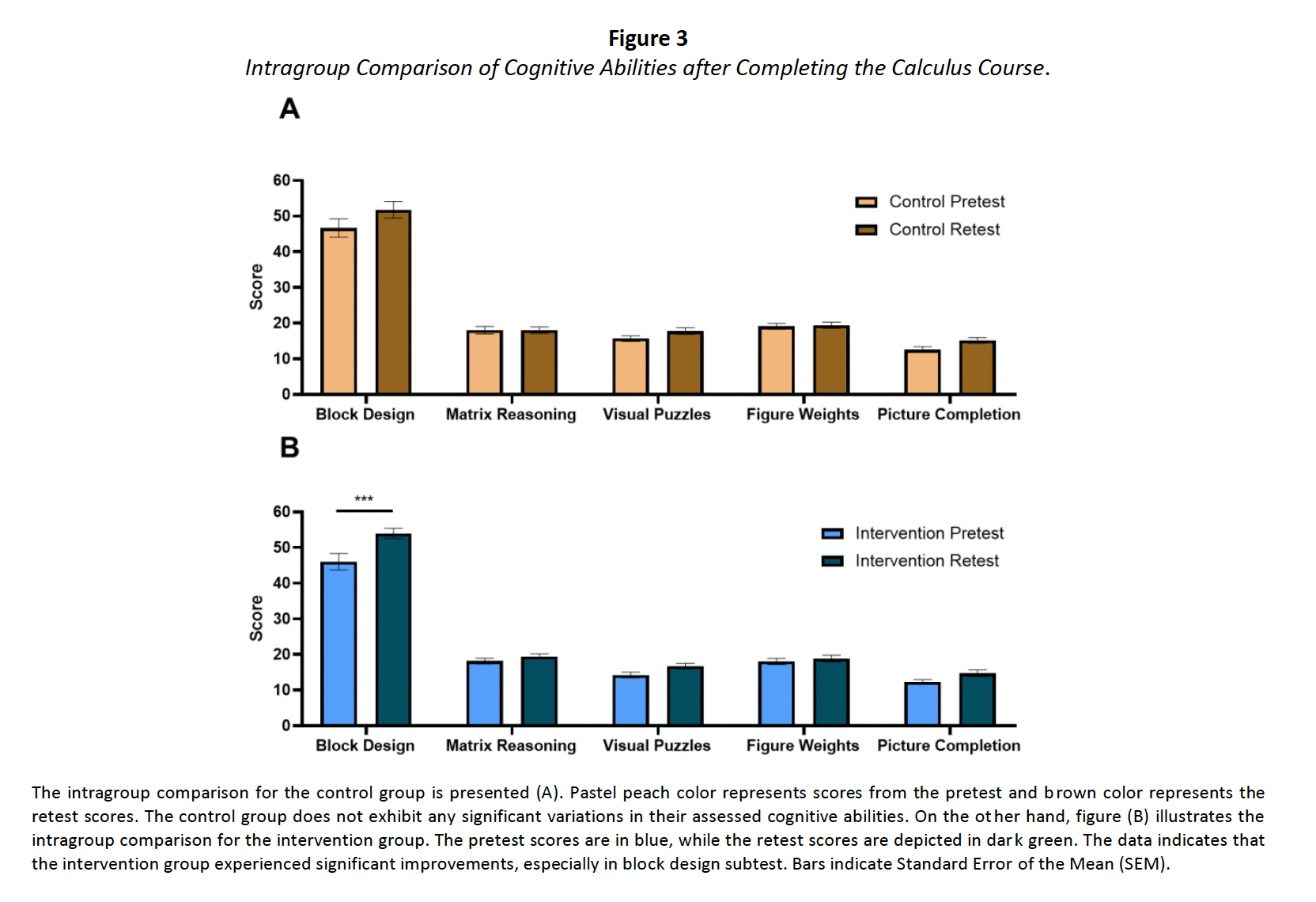
Calculus, a cornerstone of mathematics that explores continuous change through differentiation and integration, is pivotal for higher education in engineering and STEM careers. Yet, its instruction presents challenges, with many students grappling with its complexity, accentuating the need for innovative teaching strategies. Grounded in the nexus between calculus and higher cognitive functions, this research evaluates the outcomes of a student-centered approach in enhancing understanding and applying calculus and seeks to determine its impact on broader cognitive functions. Employing a pretest-retest design with control and intervention groups, we merge cognitive evaluations, including subtests from the Wechsler Adult Intelligence Scale, with calculus performance assessments. Our results revealed the intervention group exhibited enhanced calculus performance and improvement in the perceptual reasoning index, especially in block design subtest, reflecting enhanced visuospatial skills. This study offers valuable perspectives for improving calculus instruction and potentially improving students' cognitive capabilities by implementing a student-centered approach.
Keywords: Calculus; Education; Cognitive Functions; Visuospatial abilities.
Downloads
Additional Files
Published
How to Cite
Issue
Section
License
Copyright (c) 2026 Raúl D. Jiménez , Susana Arancibia-Carvajal , Walter Terrazas-Nuñez , Ema Huerta , Loreto Fuentes , Nathalia Herrán , Marcos Domic-Siede

This work is licensed under a Creative Commons Attribution-NonCommercial-ShareAlike 4.0 International License.
Articles published in this journal are protected under the Creative Commons Attribution-NonCommercial-ShareAlike 4.0 International (CC BY-NC-SA 4.0) license. This means that authors retain full rights over their research and publications at all times. As a journal, we fully respect and promote the principles of open access established by this license, allowing the work to be shared, adapted, and distributed for non-commercial purposes, provided that appropriate credit is given to the authors and any derivative works are licensed under the same terms.
Authors are responsible for obtaining the required permission when they wish to reproduce part of the material (figures, etc.) from other publications.
Likewise, CNPs allows authors to host in their personal sites or other repositories that they deem convenient the Final and Definitive Version of the published article with the format assigned by the journal. In no case do we allow access to preprints of the article under evaluation or already published.
When submitting an article to CNPs you are aware that all the contents of CNPs are under a Creative Commons License. In which it is allowed to copy and share the contents freely, always making reference to the origin of the publication and its author.