A LOOK AFTER STROKE: DEFICITS IN THEORY OF MIND AND SOCIAL COGNITION IN SUBACUTE PATIENTS
Abstract
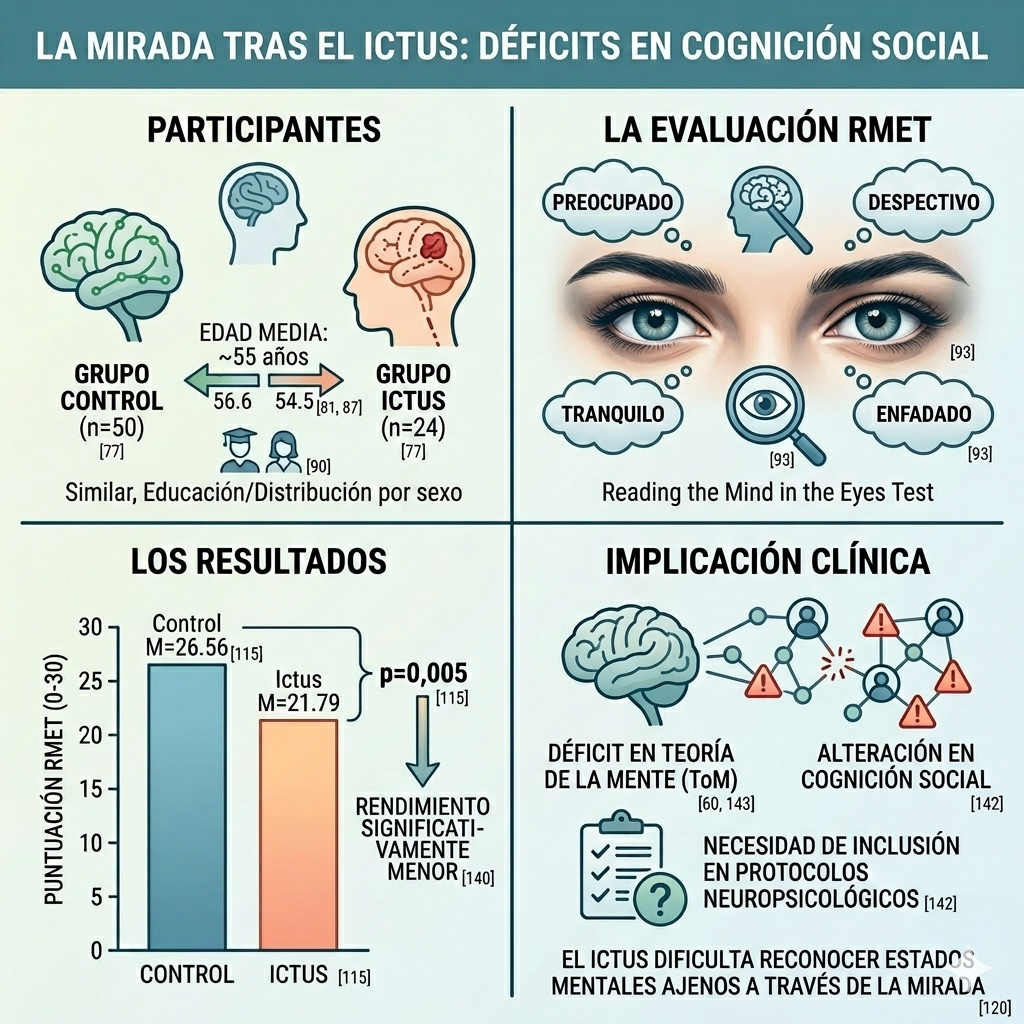
Stroke generates motor, cognitive, behavioral, and emotional deficits that impact the quality of life of those affected. Within the cognitive sphere, alterations in so-called social cognition can be observed. This study analyzes the ability of a group of 24 people with a subacute stroke to recognize the mental state of others through their gaze (mean age: 54.5 years; SD: 6.8). To this end, their performance on the Reading the Mind in the Eyes Test (RMET) was compared with that of a control group of 50 people without neurological history (mean age: 56.6 years; SD: 12.6). The results show that people with stroke performed significantly worse on the RMET than people without neurological history (M: 21.79; SD: 7.12 vs. M: 26.56; SD: 3.82; p=0.005). These findings show that people with stroke experience difficulty recognizing the mental state of others through their gaze and highlight the need to include tests that assess social cognition in neuropsychological examination protocols.
Key Words: SC; stroke; RMET; emotional recognition.
Published
How to Cite
Issue
Section
License
Copyright (c) 2026 Pablo Rodríguez Rajo, María Valentina Ampuero, Antonia Enseñat , Alberto García-Molina

This work is licensed under a Creative Commons Attribution-NonCommercial-ShareAlike 4.0 International License.
Articles published in this journal are protected under the Creative Commons Attribution-NonCommercial-ShareAlike 4.0 International (CC BY-NC-SA 4.0) license. This means that authors retain full rights over their research and publications at all times. As a journal, we fully respect and promote the principles of open access established by this license, allowing the work to be shared, adapted, and distributed for non-commercial purposes, provided that appropriate credit is given to the authors and any derivative works are licensed under the same terms.
Authors are responsible for obtaining the required permission when they wish to reproduce part of the material (figures, etc.) from other publications.
Likewise, CNPs allows authors to host in their personal sites or other repositories that they deem convenient the Final and Definitive Version of the published article with the format assigned by the journal. In no case do we allow access to preprints of the article under evaluation or already published.
When submitting an article to CNPs you are aware that all the contents of CNPs are under a Creative Commons License. In which it is allowed to copy and share the contents freely, always making reference to the origin of the publication and its author.