EMOTIONAL ACTIVATION, COGNITIVE LOAD, AND ENGAGEMENT: NEUROPSYCHOLOGICAL CORRELATES IN TEACHERS' ADOPTION OF PEDAGOGICAL STRATEGIES
Abstract
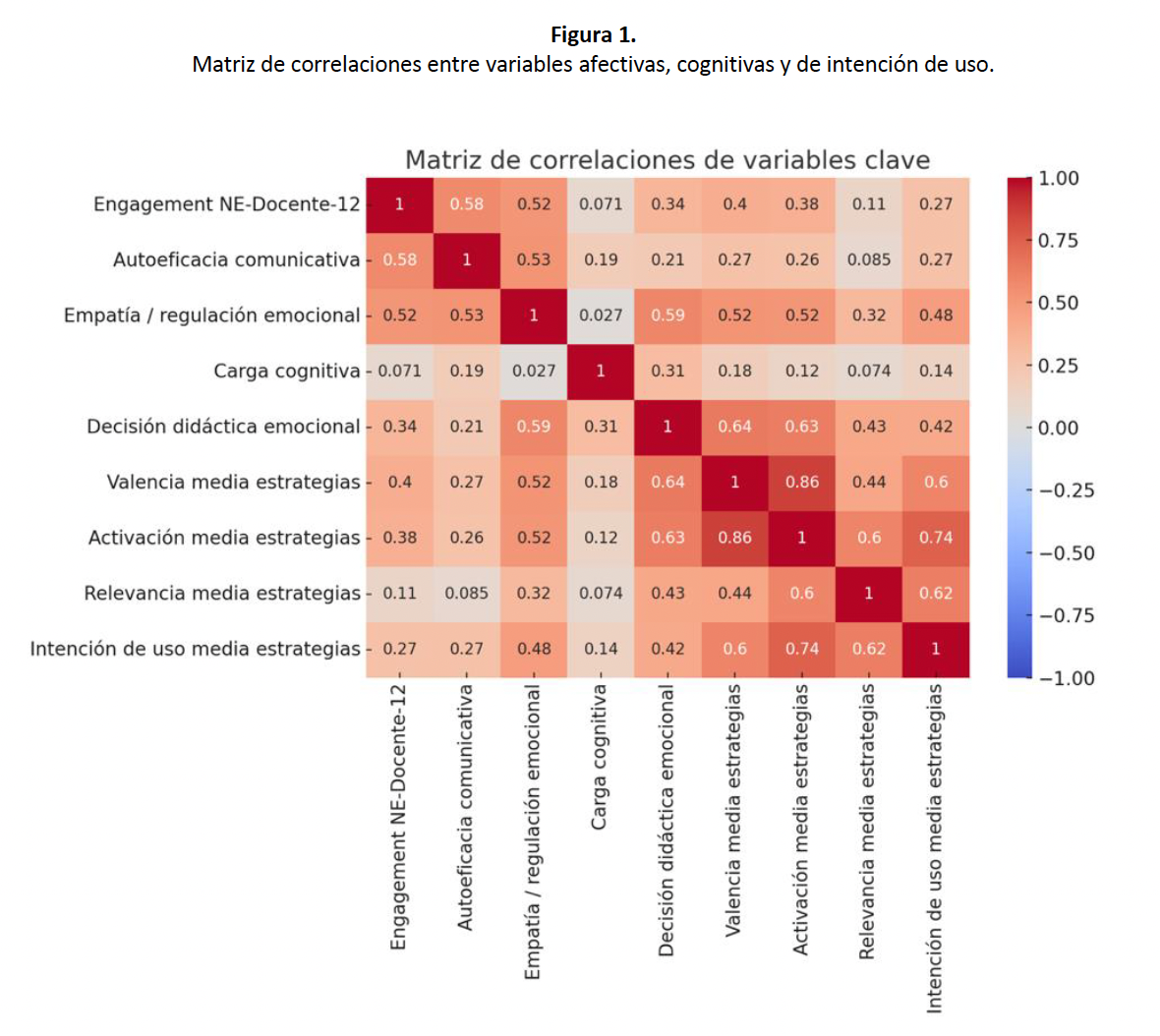
This article analyzes how emotional perception and neurocommunicative variables such as engagement, empathy, communicative self-efficacy, and cognitive load influence university teachers' intention to use teaching strategies. The study is based on the need to understand how teachers' emotions condition methodological adoption. A quantitative, non-experimental, cross-sectional approach with a correlational-explanatory scope was used. The sample consisted of 86 university teachers, and data were collected using the psychometrically validated PE-ENDU questionnaire. The analysis included descriptive statistics, Pearson correlations, and multiple regression developed in Python. The results show positive relationships between intention to use and valence, activation, and emotional relevance, as well as engagement and empathy-emotional regulation. Cognitive load did not have any significant negative effects. The predictive model explained 65% of the variance in intention to use. It is concluded that emotional and neurocommunicative processes are determinants in the adoption of active strategies, highlighting the importance of emotional well-being and communicative self-efficacy for pedagogical innovation.
Published
How to Cite
Issue
Section
License
Copyright (c) 2026 Macarena Cortés-Vázquez , Alicia Villán Rodríguez

This work is licensed under a Creative Commons Attribution-NonCommercial-ShareAlike 4.0 International License.
Articles published in this journal are protected under the Creative Commons Attribution-NonCommercial-ShareAlike 4.0 International (CC BY-NC-SA 4.0) license. This means that authors retain full rights over their research and publications at all times. As a journal, we fully respect and promote the principles of open access established by this license, allowing the work to be shared, adapted, and distributed for non-commercial purposes, provided that appropriate credit is given to the authors and any derivative works are licensed under the same terms.
Authors are responsible for obtaining the required permission when they wish to reproduce part of the material (figures, etc.) from other publications.
Likewise, CNPs allows authors to host in their personal sites or other repositories that they deem convenient the Final and Definitive Version of the published article with the format assigned by the journal. In no case do we allow access to preprints of the article under evaluation or already published.
When submitting an article to CNPs you are aware that all the contents of CNPs are under a Creative Commons License. In which it is allowed to copy and share the contents freely, always making reference to the origin of the publication and its author.